FLOATING
TERMINALS
A floating terminal can be used as a temporary facility for a large construction project or a permanent facility for terminals with insufficient space on land.
One of the unique characteristics of a floating terminal is the capability to be stationed up to 200 meters offshore and pumping the cement or fly ash to shore via a floating pipeline. Therefore, the terminal does not need any dock. Another characteristic of a floating terminal is to act as extra storage for loading ships, bagging plants or even bulk trucks on the dock.

System Configurations

Airslide loading system
Airslide loading system
Airslide loading systems use a slope that harnesses gravity to convey fine powders. This is achieved by forcing air through a porous fabric for the required fluidisation. The steel-structure boxed frames & housings, abrasion-resistant polyester fabric, and high-quality blowers combine to form rugged and versatile loaders to handle materials like cement, alumina, and hydrated lime, fly ash and plastic powders. Additionally, air-slide-based loaders are fully enclosed and self-cleaning and have no moving parts. This means they are quiet, dust-free and require almost no maintenance.
Material is loaded for transport pneumatically or mechanically. The central loading point with air slides, fitted with valves and drop-off pipes, distributes the dry material over the holds.
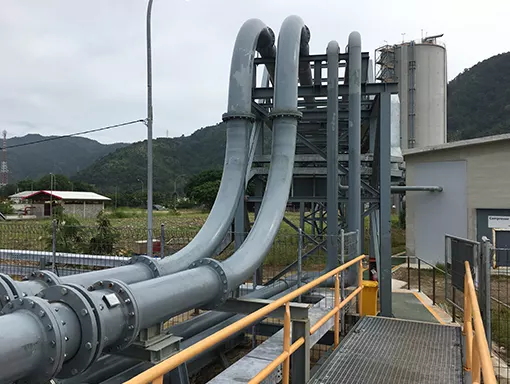
Pipeline Loading system
Pipeline Loading system
The pneumatic loading principle is utilized when a ship is loaded through a pipeline system. In this case, the cement is transported via a pneumatic conveying system all the way to the ship through a pipeline. A flexible rubber hose connects the pipeline onshore with the ship’s onboard pipeline.

Mounted ship unloader
Mounted ship unloader
A floating terminal mounted ship unloader is ideal for unloading open top ships or barges into the floating terminal. Large tidal differences do not influence the length of the suction arm, as the terminal and bulk carrier are both floating.

Terminal-to-silo conveying
Terminal-to-silo conveying
Terminal-to-Silo Conveying uses a completely closed bulk handling unloading system, like a Double Re-Loader system. This unloading system is integrated into the floating terminals hull and uses a vacuum and pressure to convey the dry bulk material into the silo directly. Our Floating Terminal solutions are included with a Fluidization floor for unloading the cargo from the holds in every weather condition.

Terminal-to-ship conveying
Terminal-to-ship conveying
A Floating Terminal can be used as a permanent dock storage facility for dry bulk materials when the shore does not have enough space or suitable storage facilities available. But a floating Terminal can also be used as a loading station on the open sea for loading (smaller) ships for supplying inland storage locations.
A specially designed ship loading bellows for gravity loading or pipeline loading system can be installed for loading ships from the floating terminal. Both solutions use a vacuum to retrieve the dry bulk material from the cargo holds.

Terminal-to-truck conveying
Terminal-to-truck conveying
When a Floating Terminal is used as a permanent dock storage facility for dry bulk materials and no storage facilities are not available, Terminal-to-truck conveying is an excellent solution. Terminal-to-truck solutions use the continuous suction pump solution, which uses only a vacuum and the CSP-pump to convey the dry bulk material from the Floating terminal towards the bulk trucks on the dock site.
Social Media
Stay up to date with the latest developments at Lion Marine Group.