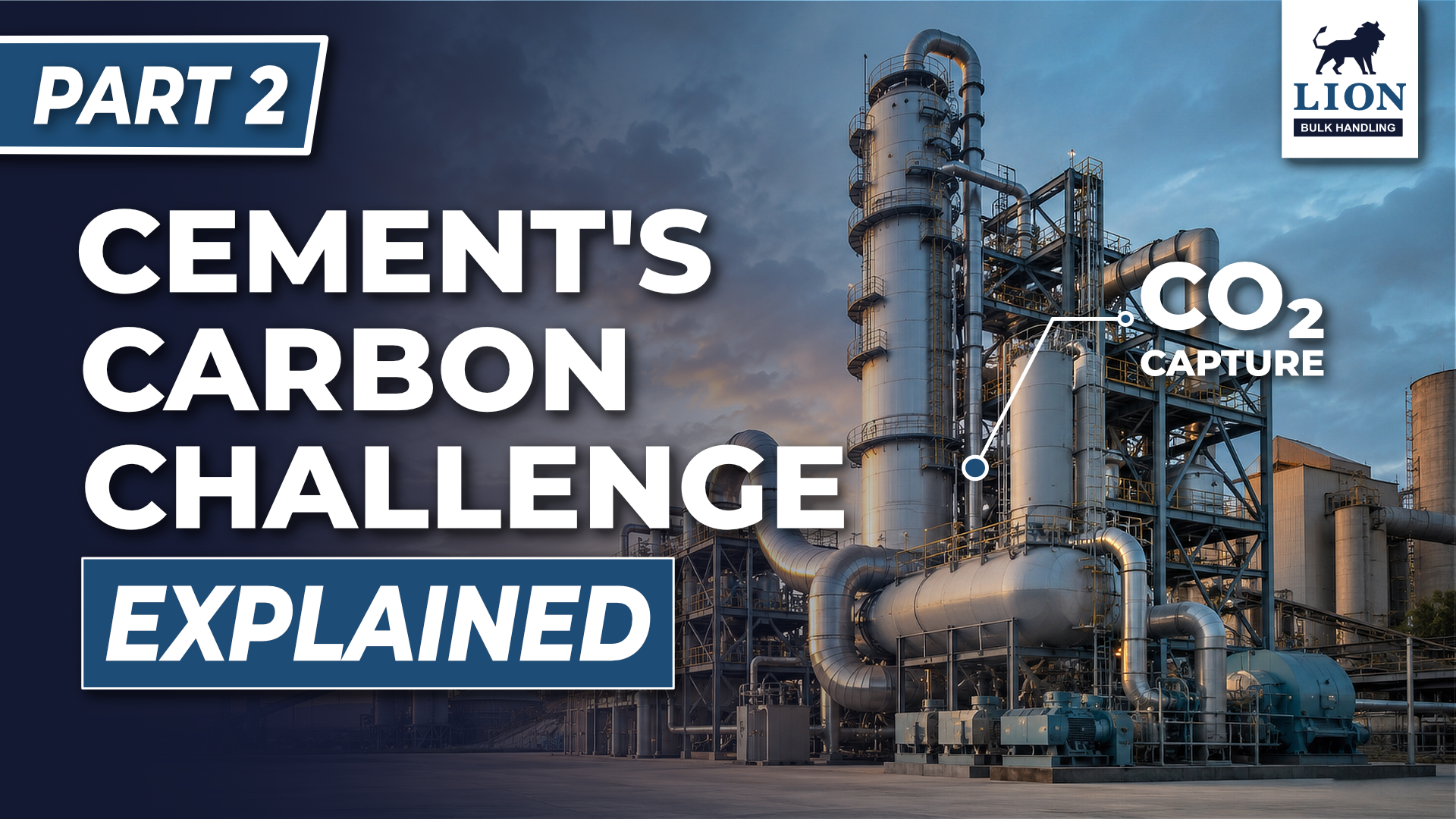
Cement production is responsible for around 7% of global CO₂ emissions, making it one of the most carbon-intensive industrial processes. These emissions come not only from the energy needed to heat cement kilns, but also from a chemical reaction that occurs when limestone is transformed into clinker.
In Part 1 of The Carbon Challenge in Cement, EXPLAINED by Lion explores where cement emissions come from, why clean energy alone cannot eliminate them and why reducing cement’s carbon footprint requires changes across the entire production process.
Why does cement production create so much CO₂?
Cement production requires extremely high temperatures. Inside a cement kiln, raw materials are heated to around 1,450°C to produce clinker, the intermediate material used to make cement.
Traditionally, this heat is generated using fuels such as coal, petroleum coke or natural gas. Fuel combustion is therefore an important source of cement-related CO₂ emissions.
But replacing fossil fuels does not solve the entire problem.
A larger challenge comes from the limestone itself.
What is calcination in cement production?
Limestone contains calcium carbonate (CaCO₃). When it is heated during cement production, it breaks down into calcium oxide and carbon dioxide.
This chemical reaction is known as calcination.
Calcination is responsible for roughly 60% of the direct CO₂ emissions associated with conventional cement production, while fuel combustion accounts for approximately 40%.
Because these process emissions are created by the chemistry of producing clinker, switching a cement plant entirely to low-carbon energy would still leave a significant amount of CO₂ emissions.
How can cement emissions be reduced?
There is no single solution to decarbonizing cement.
Potential strategies include:
- improving energy and plant efficiency;
- replacing fossil fuels with lower-carbon alternatives;
- reducing the amount of clinker used in cement;
- using supplementary or alternative cementitious materials;
- using concrete and cement more efficiently;
- capturing and storing unavoidable CO₂ emissions.
Reducing cement emissions therefore requires changes across the complete system — from raw materials and clinker production to energy use, material efficiency and carbon capture.
Cement remains essential for buildings, roads, bridges, ports and infrastructure around the world. The challenge is not simply to stop using cement, but to find ways to produce and use it with a much smaller carbon footprint.
Watch The Carbon Challenge in Cement (Part 1) | EXPLAINED by Lion
Discover where cement’s carbon emissions come from and why decarbonizing one of the world’s most important construction materials requires more than simply switching to clean energy.
Sources
- 𝗜𝗻𝘁𝗲𝗿𝗻𝗮𝘁𝗶𝗼𝗻𝗮𝗹 𝗘𝗻𝗲𝗿𝗴𝘆 𝗔𝗴𝗲𝗻𝗰𝘆 (𝗜𝗘𝗔): https://www.iea.org/energy-system/industry/cement
- 𝗖𝗵𝗲𝗻𝗴 𝗲𝘁 𝗮𝗹., 𝗡𝗮𝘁𝘂𝗿𝗲 𝗖𝗼𝗺𝗺𝘂𝗻𝗶𝗰𝗮𝘁𝗶𝗼𝗻𝘀: https://www.nature.com/articles/s41467-023-43660-x
- 𝗚𝗹𝗼𝗯𝗮𝗹 𝗖𝗲𝗺𝗲𝗻𝘁 𝗮𝗻𝗱 𝗖𝗼𝗻𝗰𝗿𝗲𝘁𝗲 𝗔𝘀𝘀𝗼𝗰𝗶𝗮𝘁𝗶𝗼𝗻: https://gccassociation.org/wp-content/uploads/2024/11/GCCA-Cement-Industry-Progress-Report-202425.pdf
- 𝗨.𝗦. 𝗗𝗲𝗽𝗮𝗿𝘁𝗺𝗲𝗻𝘁 𝗼𝗳 𝗘𝗻𝗲𝗿𝗴𝘆: https://www.energy.gov/sites/default/files/2024-03/Industry%20Guide%20to%20CCS%20at%20Cement%20Plants_Nov%2029%202023.pdf